AI ARCHITECT · MONTRÉAL, QUÉBEC
Elias Tanbe.
Artificial Intelligence
Architect.
I help companies in Québec and across Canada explore AI in three stages, with people kept in control.
Take the 1-minute AI checkAI ARCHITECT · MONTRÉAL, QUÉBEC
Artificial Intelligence
Architect.
I help companies in Québec and across Canada explore AI in three stages, with people kept in control.
Take the 1-minute AI checkFREE · 1 MINUTE · 5 QUESTIONS
Answer five questions and see which of the three stages fits you today: explore, pilot or deploy. Your answers stay in your browser.
YOUR STARTING POINT
Readiness 0/10
Start by finding the right task. You don’t need a tool yet. We map your work with the people who do it, rank the use cases by value, risk and effort, and check your Law 25 obligations before any data moves.
You are ready to prove one use case. Test it on your real data, with success criteria agreed up front and people approving what the AI produces.
Your pilot works. The next step is production: security, monitoring, cost control and a team trained to run it.
Write to me with your starting point and the task you have in mind. I’ll tell you honestly whether AI is worth it, and you get a quick written quote before any commitment.
Write to me: elias.t@inquisitiveflow.ca
SERVICES / THREE STAGES
Most companies don’t need another AI strategy deck. They need to know where AI helps their work, prove it on one real case, then make it part of daily work. Each stage is quoted on its own, quickly and in writing, and ends with a decision that stays yours: continue, adjust or stop.
01Explore
We map your processes, data and constraints with the people who do the work. I check your privacy obligations under Québec’s Law 25 before any data moves.
You leave withUse cases ranked by value, risk and effort, and a clear recommendation to go ahead or not.
In practiceOYEE helps people understand AI through questions and examples, in French and English, with in-person workshops in Québec.
02Pilot
We agree on success criteria before anything is built. I build a working pilot where people review and approve what the AI produces, then measure it against how you work today.
You leave withA working pilot, measured results and an honest recommendation.
In practiceHaulView · Iris prepares each offer
and the dispatcher approves it. In development; client details stay
confidential.
Adra a working
prototype built solo in five hours, top 4 of about 30 teams at Mila
Ventures’ Build OS26.
03Deploy
I take the pilot to production with security, monitoring, cost control and the human checkpoints that remain. Your team is trained to run it.
You leave withA system in production, its documentation and a team that can run it.
In practiceMnemosyne a bilingual learning product in production, used by real learners.
ABOUT / WHO YOU WORK WITH
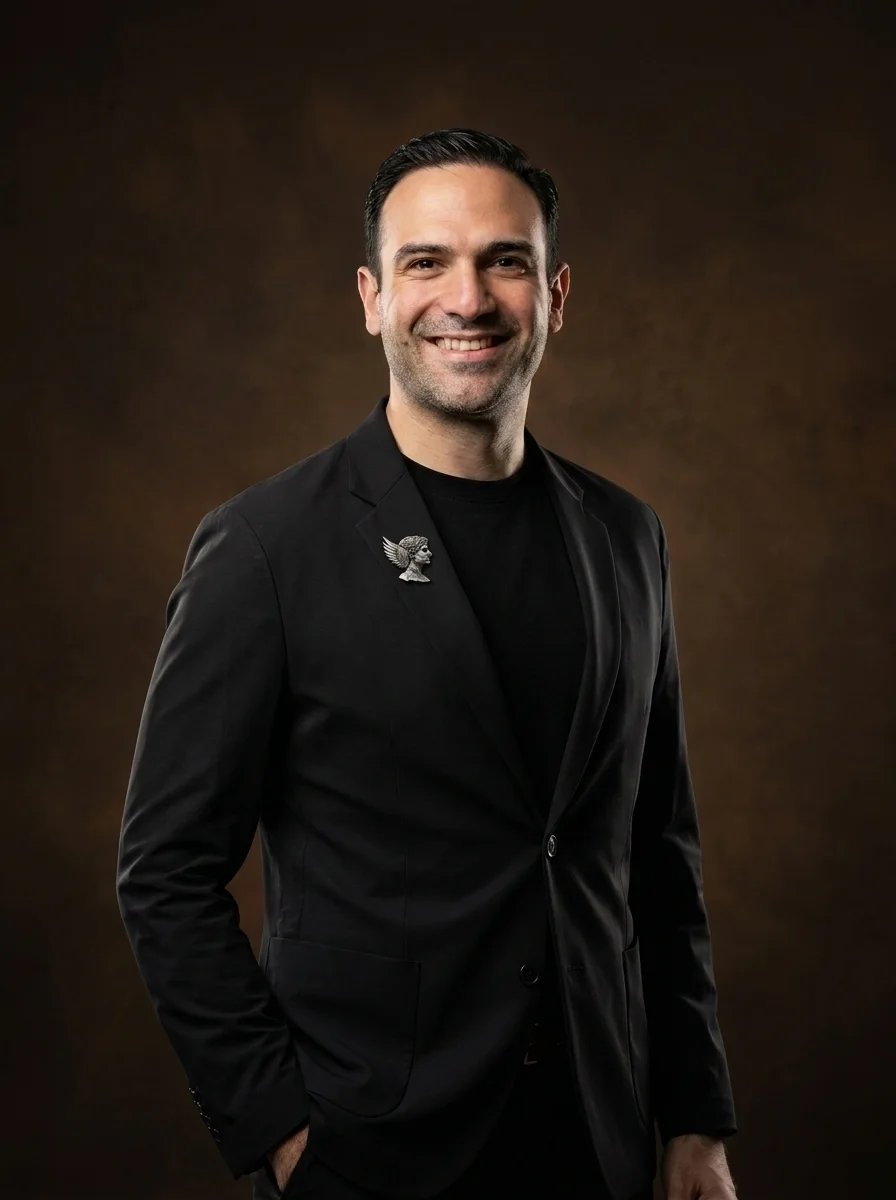
I’m an AI architect in Montréal, and I write the code myself. I design, build and run AI systems: learning products used by real learners, operations tools where a person approves what the AI prepares, and multi-agent reviews. I founded Inquisitive Flow Learning, and my experience as an educator shapes how I bring teams along.
Across my products: PostgreSQL · Redis
WHAT I’VE BUILT
LIVE / EDUCATION
Learning that remembers
the learner.
A bilingual learning product with working, episodic and semantic memory, and an Aegis layer that verifies what the tutor tells a learner.
Explore Mnemosyne ↗IN DEVELOPMENT / OPERATIONS
AI assistance.
Human responsibility.
A complex operations product with an AI layer called Iris. The system can prepare an offer, but the dispatcher approves it. The challenge is coordinating assistance without obscuring who makes the decision.
Discuss HaulView on LinkedIn ↗HACKATHON / MULTI-AGENT REVIEW
Several perspectives.
One considered judgment.
A typed pipeline classifies and decomposes a proposal, runs five specialist auditors in parallel, synthesizes their findings and invokes a separate critic. Targeted follow-up is bounded by three critic passes.
See the Adra story ↗LIVE / AI LITERACY
Understand AI.
One question at a time.
An interactive way to explore AI through questions, examples and personal learning routes, alongside in-person workshops in Québec.
Visit OYEE ↗RESEARCH / ON MY OWN TIME
Beside my client work, I run two research experiments on my own time. Both follow an academic approach: a clear question, a hypothesis, a test, and results I can defend. They are in progress, so no results are published yet.
01Memory
I study how people remember what they learn: what helps knowledge last, what lets it fade, and what that means for AI built to support learning.
StatusIn progress. No results published yet.
02Hypotheses
I study whether an AI system can work the way a researcher does: form a hypothesis, decide how to evaluate it, then test it in code to confirm or reject it. The aim is an academic method, not a confident guess.
StatusIn progress. No results published yet.
Working on memory, hypothesis testing or coding agents? I like comparing notes with other builders and researchers.
QUESTIONS
An AI architect decides how AI fits into a company’s work: which tasks it takes on, which data it may use, how its output is checked and where a person decides. I design that system, build it and make sure it runs safely at a known cost.
The architect decides how the whole system fits the work: what AI takes on, which data it may use, how its output is checked, what it costs and where a person decides. AI engineering is building it: the code, the integrations, the tests and the production setup. I design the system and write the code myself, so the design is proven in working software rather than left in a slide deck.
Mnemosyne, a bilingual learning product in production with real learners, with memory and a layer that verifies what the tutor says. HaulView, an operations product in development where its AI layer, Iris, prepares each offer and a dispatcher approves it. Adra, a multi-agent review prototype built solo in five hours, top 4 of about 30 teams at Mila Ventures’ Build OS26. And OYEE, a bilingual way to understand AI, with workshops in Québec. I also built learning products and free tools for educators at Inquisitive Flow Learning.
With its own work, not with a tool. In the Explore stage we list the tasks where AI could help, rank them by value, risk and effort, and choose one to prove in a pilot.
It depends on the stage and the size of the problem, so I don’t publish fixed prices. After a 30-minute call you get a quick written quote for the stage you need, before any commitment.
From the first stage. We identify the personal information involved, keep only what is needed and complete a privacy impact assessment when the law requires one. When data must stay in Canada, the architecture and the AI providers are chosen accordingly. For legal opinions, I work with your counsel.
Yes. I work in French and English, and I also speak Arabic. Workshops, documentation and the AI systems themselves can be in French, English or both.
I’m based in Montréal and work with companies across Québec and the rest of Canada, on site or remotely.
A problem worth solving, someone who knows the work well, and examples of the documents or data involved. You don’t need a data science team to begin.
You decide. If the pilot meets the criteria we set together, we move to deployment. If it doesn’t, you keep the findings and we adjust or stop. A pilot that says no is also a useful result.
The ones that fit your constraints: quality in your language, cost, privacy and where data may be processed. I compare options on your own examples instead of choosing a vendor in advance.
Python, TypeScript, JavaScript, Swift and SQL, with FastAPI, React, Node.js and Three.js, PostgreSQL and Redis, on AWS, DigitalOcean, Cloudflare and Google Cloud. The work goes through Git and GitHub, with code review and CI/CD.
HOW I BUILD / WHY A COLONY?
The larger structure emerges from small actions, shared signals and different roles. That is how I build agentic systems: one agent gathers context, another challenges it, another brings the work together. I design those relationships, the checks between them and the moments where a person must decide.
THE COLONY / SIDE VIEW
Each route is one part of how I build. Each chamber is one decision inside it. Choose a chamber to step inside.
START WITH A CONVERSATION
A 30-minute call is enough to see whether AI fits and which stage to start with. You then get a quick written quote, before any commitment. In French or English.
Or write to me directly: elias.t@inquisitiveflow.ca
I like comparing notes with other builders and researchers, on my two experiments in progress or on what you are building.